Over the past few years, the world has lost billions of dollars due to thefts, hacks, and simple human negligence. Mt.Gox — 450,000 bitcoins (about $450 million at the time) — vanished without a trace. In 2021, Poly Network hackers took nearly $610 million but then unexpectedly returned the money — a rare case. In this article, I won’t scare you with horror stories but will provide a real, proven arsenal for reliably protecting your digital assets.
How to Secure Your Cryptocurrency Assets: Best Storage Practices

If you think storing cryptocurrency is just about setting a password and forgetting it, I have bad news for you. The crypto world is more like an arena of gladiators where your money depends on your vigilance and the technologies you use.
How and why people lose cryptocurrency: real case overview
Largest thefts and losses in crypto history
| Name | Losses (BTC/USD) | Year | Reason |
|---|---|---|---|
| Mt.Gox | 850,000 BTC (~$450 million) | 2014 | Hacking and poor management |
| Bitfinex | 120,000 BTC (~$72 million) | 2016 | Exchange hack |
| Coincheck | $530 million in NEM | 2018 | Wallet hack without multisig |
| Poly Network | $610 million (returned) | 2021 | Smart contract vulnerability |
| Binance | 7,000 BTC (~$40 million) | 2019 | Hot wallet hack |
Why do people lose crypto?
- Phishing — the most common attacks where you’re tricked into revealing private data
- Exchange and service hacks — exchanges keep billions in hot wallets and are tempting targets
- User errors — losing seed phrases, improper backups, accidental wallet deletion
- Fraud and social engineering — traps for the greedy and trusting
Some fictional scenarios for better understanding
Case #1: classic phishing — “gave it all away”
Situation:
A user in Germany receives an email from “MetaMask support” asking to confirm their seed phrase “for security reasons.” The site is a clone. They enter the phrase and lose $80,000 in ETH.
Lesson:
Even tech-savvy people fall for it. A cold wallet plus paranoia about links is mandatory. MetaMask never asks for seed phrases.
Case #2: losing seed phrase = losing everything
Situation:
A crypto enthusiast had a paper copy of their seed phrase at home. Fire. The cold wallet was safe, but without the seed phrase, access recovery is impossible. $120,000 in BTC lost forever.
Lesson:
One paper copy is not enough. Make 2–3 copies and keep them in different places, like with a notary, in a bank safe, or with a trusted person.
Case #3: exchange leaves country → your money gets stuck
Situation:
In 2023, Binance left Canada. Traders had 30 days to withdraw funds. Many ignored news, thinking “later.” Result — accounts frozen, withdrawals slowed or require jurisdiction moving.
| Exchanges that left or limited country access |
|---|
| Binance — Canada, Netherlands, USA (partly) |
| Bybit — France, Netherlands |
| OKX — USA, some states |
Lesson:
Follow the news about exchanges holding your funds. Subscribe to their official Twitter and Telegram. Use only platforms with stable licenses and jurisdictions in your country.
Case #4: deposited money but can’t complete KYC
Situation:
A user from Ukraine deposits $15,000 on KuCoin. Trading was fine. When withdrawing, the system requires KYC. Passports rejected due to old format, no English transliteration. Account frozen.
Lesson:
Check first whether KYC is possible in advance and if the exchange accepts documents from your country, especially if you lack a passport or live in an unstable jurisdiction.
💡 Tip: To avoid “can’t withdraw” situations, complete KYC immediately after registration — while you can.
Case #5: account blocked without explanation
Situation:
A user from Iran uses a decentralized protocol through MetaMask. Later, MetaMask blocks access to RPC servers — wallet technically won’t work without VPN.
Lesson:
Even “decentralization” relies on centralized servers. Use your own RPC nodes or alternatives (Infura, Alchemy, Ankr, etc.). Use VPN if your country is sanctioned.
🛑 Technical and legal risk = risk of loss
| Risk Type | What happens | How to avoid |
|---|---|---|
| Exchange leaves country | Account blocked or withdrawal limited | Follow news and email alerts |
| Unable to pass KYC | Funds stuck without access | Check accepted ID list early |
| Jurisdiction disputes | Exchange banned by government | Use cold wallets |
| Service blocks | IP, geo, sanctions restrict access | VPN, decentralized wallets and bridges |
📌 Final checklist: protect yourself from surprises
- Confirm the exchange works in your country
- Complete KYC before depositing large sums
- Store main crypto in a hardware (cold) wallet
- Have at least two paper copies of seed phrases in different places
- Subscribe to official channels of exchanges and wallets you use
- Know alternatives if services get blocked
- Don’t keep crypto on exchanges longer than needed for trading
- Never enter seed phrases in browsers or via email links
📎 Crypto philosophy:
In crypto, everyone has their own keys and their own pitfalls. People lost millions simply because they didn’t read news, made no backups, skipped 2FA, or thought “I’ll do it later.”
Security is not a feature. It’s a lifestyle in crypto.
Main vulnerabilities in cryptocurrency storage
The key is the only way to control crypto. Lose the key — lose the money, no matter what anyone says.
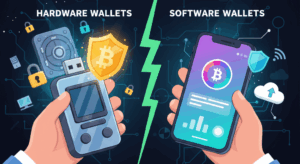
Hot vs cold wallets
| Wallet Type | Description | Pros | Cons |
|---|---|---|---|
| Hot | Connected to the internet | Fast access, good for trading | Vulnerable to hacks and phishing |
| Cold | Offline device or paper key | Maximum security | Harder access, risk of physical loss |
Devices and software
Computers and smartphones are not just tools but potential enemies if you don’t update software, use antivirus, and monitor networks.
Best storage practices that really work
Hardware wallets
Ledger Nano S, Ledger Nano X, Trezor — trusted devices that store keys in a secure environment.
- Cost from $50 to $200, a small price for the protection they provide.
- Don’t connect to suspicious computers.
- Make paper backups of seed phrases, not digital ones on phones.
Paper wallets
A simple but effective method. Generate private key and address offline, print on paper, keep in a safe. Main downside — paper can burn or be lost.
Multisignature wallets (Multisig)
Like a bank safe with multiple keys. Requires 2 of 3 signatures to perform operations, protecting against theft if one key is compromised.
Reducing risks with hot wallets
- Use separate wallets for small operations and active trading
- Enable two-factor authentication (2FA) with Google Authenticator or hardware tokens
- Never store private keys in browsers or cloud storage like Google Drive
Software security measures
| Security Measure | Why Important |
|---|---|
| Software and OS updates | Close vulnerabilities and bugs |
| Antivirus and firewall | Block trojans and keyloggers |
| Passwords and biometrics | Control device access |
| Disk encryption | Protect data if device is lost or stolen |
Social engineering and phishing — traps for crypto investors
Phishing is when you’re lured to fake sites, input passwords, and lose your wallet.
Examples of traps
- Fake links in social media and emails
- Messages from fake support asking to confirm data
- Fraudulent apps and browser extensions
How to protect yourself?
- Check URLs — official sites almost always use HTTPS and known domains
- Don’t click suspicious links
- Use hardware wallets — they won’t give keys to phishers
How not to fall victim to scammers: proven tips
- Don’t fall for “too good to be true” offers and guaranteed income
- Use only reputable exchanges and swap services
- Follow news and reputation of projects you invest in
Practical recommendations: security checklist for every crypto holder
| Step | Description | Important for |
|---|---|---|
| Hardware wallet | Store main crypto in a cold wallet | Everyone |
| Seed phrase backups | Multiple paper copies kept in different locations | Everyone |
| Two-factor authentication | On exchanges and wallets | Everyone |
| URL and link verification | Always manually check website addresses | Everyone |
| Software and OS updates | Keep all devices regularly updated | Everyone |
| Multisig use | For large sums and corporate wallets | Large holders |
| Device encryption | Protect data in case of theft or loss | Everyone |
What to do if theft or access loss happens?
- Immediately change access and passwords
- Contact exchange or wallet support
- Report to law enforcement (chances of recovery are low, but worth trying)
- Monitor wallet address via transaction tracking
- Psychological tip — don’t panic, crypto is not a bank but has recovery tools
Conclusion
Cryptocurrency is freedom and responsibility in one bottle. Security isn’t a one-time action but a habit and ongoing effort.
Remember: even the best hardware wallet is just part of balancing convenience and risk. Without basic security measures, your money is like a chicken in the marketplace.
Share this article with friends and help them protect themselves — crypto security starts with each of us.
Latest Articles