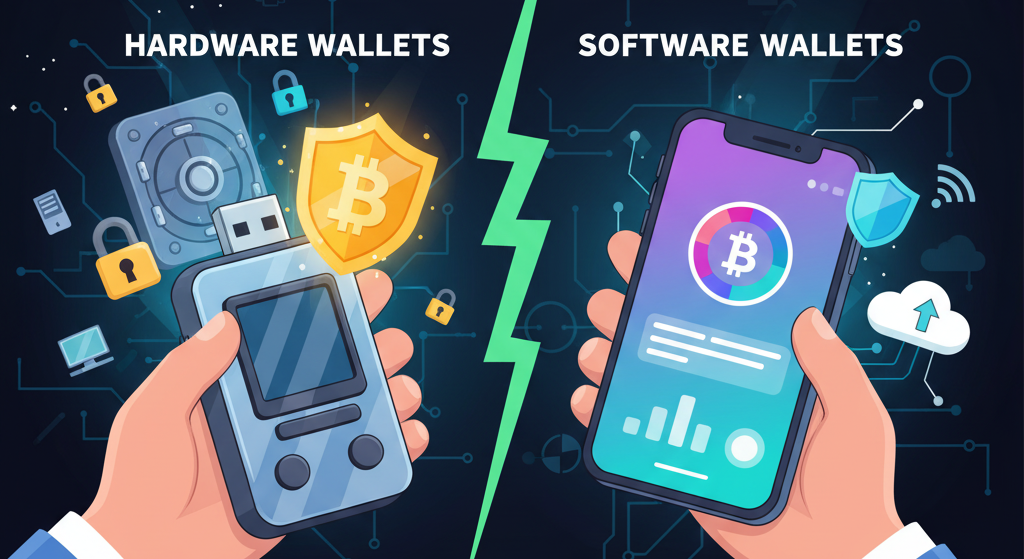
Hardware Wallets vs Software Wallets: What’s the Actual Difference?
At the core, these are two different approaches to managing private keys. Hardware wallets store keys inside a dedicated, isolated device. Software wallets keep encrypted key material on your phone or computer. Both simply provide an interface to sign transactions — they do not “hold” coins. Choosing between them means choosing a security model, an environment, and a workflow.
Key Features and Technical Breakdown
To evaluate wallets realistically, you need to understand how keys, transactions, and device security actually work — not slogans.
1
Private keys and seed phrases
Both hardware and software wallets rely on shared standards such as BIP39 for seed phrases and BIP32/44 for key derivation. The crucial difference is where private keys live: inside a secure element chip (hardware) or within your device’s encrypted storage (software). Hardware isolation prevents most remote key-extraction attacks.
2
Transaction signing
Software wallets sign transactions directly on the host device. Hardware wallets require an unsigned transaction to be sent to the device, which then displays transaction details on its own trusted screen and requires a physical confirmation. This protects against many remote manipulation attempts — assuming the user verifies the details instead of checking only a few characters.
3
Secure element vs microcontroller
Many hardware devices use tamper-resistant secure elements built to withstand physical attacks like side-channel or fault injection. While these protections dramatically raise the difficulty for attackers, high-budget labs have demonstrated rare bypasses. Hardware wallets offer significantly stronger protection, but not absolute immunity.
Pros and Cons
There is no universal winner — only better or worse fits depending on usage and threat exposure.
Pros
- Hardware: Strong protection against remote compromise; keys never touch the host OS.
- Software: Fast, convenient, often free; ideal for active or frequent use.
- Both: Standardized recovery via seed phrase.
Cons
- Hardware: Upfront cost, less convenient, possible supply-chain risks.
- Software: Vulnerable to phishing, malware, SIM swaps, and browser exploits.
- Both: Human error with seed backups remains the biggest failure point.
How These Wallet Models Actually Work
1
Software wallet flow
The app generates/imports a seed → stores encrypted keys → user creates a transaction → wallet signs it locally → the signed transaction is broadcast. Attacks at this stage target the device: keyloggers, clipboard hijackers, malicious extensions, phishing sites, and stolen backups.
2
Hardware wallet flow
The device generates the seed internally → keys never leave the secure element → the host provides an unsigned transaction → the device displays details and requires a physical confirmation → it signs internally → host broadcasts. If the host is infected, attackers may attempt subtle address-swaps or trick users into confirming malicious details — if they don’t check the device screen carefully.
3
Advanced setups
Air-gapped wallets use QR codes or SD cards to reduce exposure. PSBT workflows and multisig improve resilience, especially for institutions. MPC (multi-party computation) wallets are emerging as a hybrid alternative where full private keys never exist in one place.
Notable Security Facts and Common Misconceptions
- Hardware wallets store keys, not coins — the blockchain holds all balances.
- Clipboard hijacking can fool users even with hardware wallets if they don’t verify addresses fully.
- Ledger’s 2020 data leak didn’t expose keys but enabled aggressive phishing campaigns due to leaked customer info.
- Physical chip attacks exist but require specialized equipment and significant funding.
- Software wallets are central to DeFi usage — which is why token approval scams are so prevalent.
- Buying hardware wallets from unofficial sellers is dangerous; tampered devices are a real risk.
- Regulatory pressure affects software wallets more often, influencing available features.
Comparison With Real Alternatives
To make the abstract discussion concrete, here’s how the hardware–vs–software question compares to typical examples like MetaMask (software) and Ledger (hardware):
| Feature |
General Comparison |
MetaMask |
Ledger |
| Security |
Hardware > software for remote protection. |
Great UX, exposed to browser threats. |
Strong isolation; physical tampering still possible. |
| Supported Networks |
Software often supports new chains faster. |
Wide multi-chain support. |
Growing multi-chain support, sometimes slower for niche chains. |
| Fees |
Hardware requires a device purchase. |
Free; fees for swaps. |
One-time device cost. |
| Community Trust |
Depends on vendor transparency and incident history. |
Large base; influenced by regulatory changes. |
Reputable, but past data-leak controversies exist. |
Use Cases and Practical Recommendations
- Long-term storage: Hardware wallet or multisig; combine with metal seed backup.
- Active trading / DeFi: Software wallet for speed; keep limited funds “hot”; revoke old approvals.
- NFTs and gaming: Software for daily use; hardware integration for valuable assets.
- Institutions: Multisig, hardware modules (HSMs), MPC solutions.
- Travel or payments: Software wallets; minimize exposure and secure the device.
Risks and Limitations
Hardware risks
Physical theft, damage, counterfeit devices, supply-chain tampering, and rare but real chip-level attacks. Metadata leaks (like customer databases) can also fuel targeted scams.
Software risks
OS/browser compromise, malicious extensions, phishing domains, SIM swapping, and social engineering remain primary threats. Regulatory scrutiny can affect features or access to certain services.
Smart-contract risk
Wallet security cannot protect users from malicious or buggy contracts. Always review approvals and avoid interacting with unverified contracts.
Future Outlook
Hardware wallets will continue becoming more user-friendly, while software wallets will add stronger safety checks and compliance-aware UX. MPC and threshold signatures are likely to narrow the gap between “cold” and “hot,” enabling hybrid approaches that combine convenience with robust anti-theft properties.
Final Expert Summary
If you hold meaningful amounts of crypto, a hardware wallet — or better, a multisig configuration — is the practical baseline. For everyday use, software wallets are essential, but they should only hold operational balances. The strongest approach combines both: hardware for savings, software for spending, and disciplined seed-phrase and approval management.
Choose according to your threat model: remote attacks, phishing, physical theft, social engineering, or high-budget adversaries all point to different setups. For institutions and large portfolios, consider multisig, MPC providers, or hybrid custody. If you’d like a tailored recommendation based on your habits and portfolio size, I can help build a risk-appropriate setup.